VLX SERIES

Add local LLM inference to existing devices.

VLX-64 adds edge inference to industrial PCs, compute boxes, smart terminals and robots as an accelerator or engineering module, without replacing the existing CPU, OS or applications.

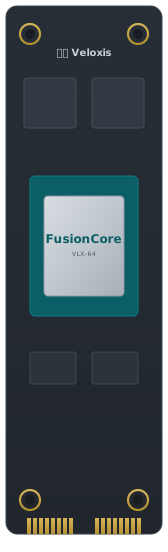
M.2 / USB · Edge inference

VLX-64

The first-generation edge accelerator targets mainstream edge models and sparse MoE evaluation, available in M.2 and USB engineering-module formats.

  • M.2:8 / 16 / 32GB
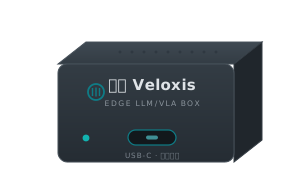
  • USB engineering module: 16GB
  • 64 TFLOPs FP4 design peak
  • Approx. 12W board power design target
PCIe / Terminal · Future roadmap

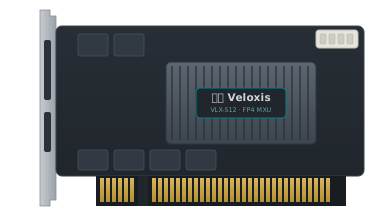
VLX-512

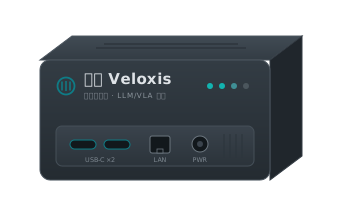
A future roadmap for workstations and larger edge systems, planned as a PCIe accelerator and a local inference terminal.

  • 512 TFLOPs FP4 long-term design target
  • 128GB memory configuration direction
  • For larger models and workloads
  • First engineering phase is centered on VLX-64

The information above includes design targets and roadmap items, not silicon measurements. Interfaces, power, software compatibility and performance are subject to the official engineering release.

FORM FACTORS

Acceleration options for different device formats.

The first product phase covers M.2 and USB engineering modules, expanding later to PCIe cards and local inference terminals.

VLX-64 M.2 accelerator
VLX-64 USB engineering module
VLX-512 PCIe accelerator roadmap
VLX-512 local inference terminal roadmap

INTEGRATION

Keep the existing platform and extend AI compute.

Evaluate integration from host interfaces and drivers to model adaptation and runtime based on real devices and workloads.

Existing device

Keep the CPU, OS, business applications and device control.

Hardware integration

Integrate based on interface, power, thermal and space constraints.

Model adaptation

Adapt models, quantization, operator compilation and runtime.

Workload validation

Evaluate throughput, latency and deployment with real tasks.

START A CONVERSATION

Bring your device and model for evaluation.

Share the target device, model scale, interfaces and deployment constraints; the team will define the product configuration and integration path.

Contact us